MEADOWBAY CELEBRATES DOUBLE WIN

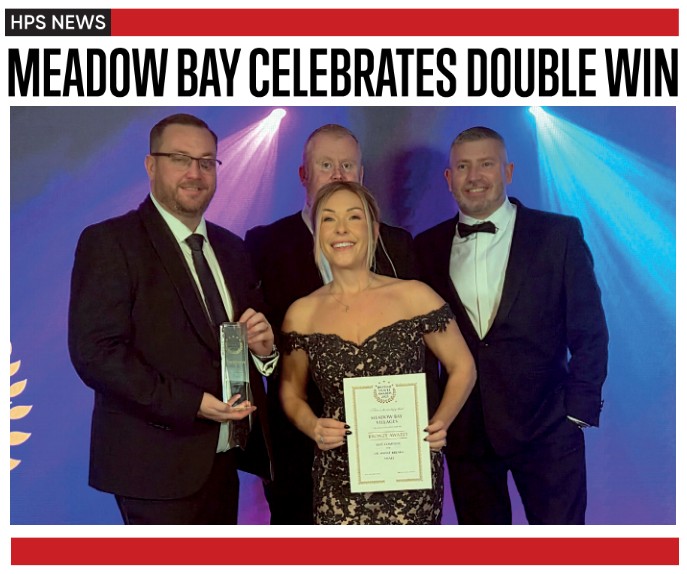
MEADOW BAY VILLAGES’ team celebrates after winning two top awards at the British Travel Awards.

Meadow Bay Villages is celebrating a double triumph at the British Travel Awards, taking home accolades as Best Small Company for UK Family Holidays and Best Small Company for UK Short Breaks.

The awards, voted for by nearly half a million consumers, are widely recognised as the most influential in the UK travel industry. Winners were announced at a ceremony at the Grosvenor House Hotel in Mayfair, attended by senior figures from across the tourism and travel sector.

Chief Executive Geoffrey Smith said the recognition was particularly special given the group has only been operating for 18 months. “To be recognised so early in our journey is incredible and reflects the commitment of our amazing team to providing outstanding holiday experiences,” he said.

Meadow Bay Villages operates four parks, including Billing Aquadrome in Northamptonshire, a peaceful lakeside retreat, and Hayling Island Holiday Park in Hampshire, which now offers luxury platinum-grade caravans with private hot tubs, as well as dog-friendly gold standard units.

The group also runs Golden Leas and Hollybush Farm Holiday Parks on the Isle of Sheppey. Over the past 18 months, Meadow Bay Villages has invested £17 million in regenerating its parks, enhancing leisure facilities and accommodation for guests and holiday homeowners.

LET’S NOT GO VIRAL!

One of the increasing risks facing all businesses is cyber-crime. Computers now sit at the centre of almost every commercial activity, enabling consumers to find what they want quickly, pay for it, and have it delivered next day or even same day. The holiday industry is no different. Consumers search for destinations, read reviews, compare prices and then book and pay online.

Computers and the internet are intrinsic to 21st century trading. As an insurance professional, one of the most challenging products to sell to a customer has been Cyber Insurance. Ten years ago, when the cover was relatively inexpensive, we couldn’t give it away — there was absolutely no interest. Fast forward to today and the environment has changed dramatically.

Cyber-crime frequently hit the headlines and claims are rising. Major companies such as Marks & Spencer, the Co-op and Jaguar Land Rover have all been affected. Even government departments have suffered from cyber-attacks.

These attacks can lead to serious business interruption, significant costs in identifying and removing malware and further investment in security to prevent recurrence. On top of this, businesses may have to face ransom demands to regain control of their systems and, if found to have inadequate security, fines imposed by the Information Commissioner’s Office (ICO).

WHAT HAS ALL THIS GOT TO DO WITH HOLIDAY PARKS?
Cyber-crime is on the rise, and in the online world no one is immune. It is easy to assume that only large companies are targeted because those incidents make the news - but they are just the tip of the iceberg.

Small businesses are frequently targeted due to;
Perceived Vulnerability: Attackers often see SMBs as easier targets with weaker security.
Data Value: Even small businesses hold valuable customer data useful for identity theft and fraud.
Supply Chain Access: Small businesses can be used as entry points into larger digital supply chains

Holiday parks typically operate websites, booking systems, computerised accounts and billing. It’s surprising how much customer data is held, and if you hold customer data, you are responsible for protecting it.

SO, WHAT ARE THE MAIN RISKS?
• Financial Costs: Direct losses from theft, ransom payments, recovery costs (IT forensics, data restoration), legal fees, and potential fines.
• Operational Disruption: Ransomware and other attacks can halt business operations for days, leading to lost income and productivity.
• Reputational Damage: A data breach can undermine years of trust and goodwill.
• Data Loss: Compromise of sensitive customer and business data, including intellectual property.
• Business Failure: A significant number of small businesses never recover from major cyber-attacks
• What exactly are cyber-attacks or cyber-crime?
• Phishing: Fake emails tricking employees into revealing credentials or installing malware.
• SQL injection: An SQL injection happens when a cyber-criminal embeds harmful code into a webpage or application to access data.
• Malware/Ransomware: Malicious software that encrypts files and demands payment for their release.
• Denial-of-Service attacks (DoS): Flooding a system with traffic to make it unusable
• Man-in-the-Middle attacks: During a man-in-the-middle cyber-attack, a cyber-criminal will intercept conversations, transactions, and the transfer of data between the victim and a service they’re trying to use.
• Social Engineering: Manipulating people through fake emails, calls, or messages to gain access.

WHAT COVER IS AVAILABLE?
There are many providers of Cyber Crime or Cyber Liability cover which keeps the market competitive. Most will offer a comprehensive cover including:
• Data breach
• Security failure
• Illegal threat
• Cyber attack

The precise scope of cover will depend on the insurer and the policy wording. If a cyber-attack strikes, policies may also help with:
• Additional business expenses
• Data recovery costs
• Public relations costs

The consequences of cyber-crime are serious for both the business and their customers. The ICO can impose fines of up to £17.5 million or 4% of a firm’s annual global turnover, whichever is higher. British Airways were fined £20M for a data breach and Marriott Hotels £18.4M. The ICO has teeth and isn’t afraid to use them!

Compass Insurance
0344 274 0276
compassparks.co.uk
CALL FOR STANDING CHARGE ACTION

The Federation of Small Businesses (FSB) has called for the energy regulator Ofgem to take action on the standing charges paid by small businesses, many of whom have seen the daily fixed price they pay, regardless of usage levels, soar over recent months.

FSB has written to Ofgem’s chief executive Jonathan Brearley to draw his attention to the issue, and to recognise the “specific, negative impact standing charges are having on small firms”. Small businesses based in rural areas have been disproportionately affected by standing charge increases, which exacerbates the existing rural-urban divide and ‘[undermines] efforts to level up more remote parts of the UK’, the FSB’s letter says.

Standing charges are used to fund network infrastructure, operating costs, and policy costs for schemes such as the Warm Home Discount, but this can be difficult for small firms to comprehend. Business customers are not covered by the energy price cap for consumers and many small firms suspect that their costs have been hiked as a result.

FSB’s Policy Chair, Tina McKenzie, commented: “We want Ofgem to do a thorough review of standing charges for businesses as well as consumers, for better transparency and to discern whether energy companies are behaving fairly towards their small firm clients. “Small business energy customers behave in a way more akin to consumers than big businesses, lacking the resources, the expertise and the buying power necessary to get the best possible deal out of their energy suppliers.

However, they do not benefit from anything like the same level of protection as that rightly available to households, leaving them caught between two stools. “Many small businesses could be forgiven for suspecting that they have been seen as something of a soft target for price hikes in their standing charges, and they do not have a full picture of where the money they pay on a daily basis is going – something that needs to change.”

SURGE IN LATE SUMMER BOOKINGS

SURGE IN LATE SUMMER BOOKINGS

LANDAL GREENPARKS UK is seeing a surge in late summer bookings at destinations such as Northumberland’s Kielder.

Managing Director of Landal GreenParks UK, says there are several factors as to why people are leaving it later and later to book their summer holiday, he says: “Summer 2023 is looking strong for domestic tourism, but there is no doubt that people have tighter budgets.

The cost-of-living crisis is still at the forefront of many people’s minds, especially when it comes to luxuries such as holidays, and we can see holidaymakers are searching for late availability and deals to help save money.

“I think it’s also fair to say that alongside the airline strike action, the latest heatwave affecting popular European package holiday destinations will leave consumers cautious of booking a holiday abroad. As a result, to avoid disruption to plans, many holidaymakers are opting to stay at home and explore what the UK has to offer.”

The south-west continues to be the best-performing region for Landal GreenParks UK, with new and additional accommodation offering at its resorts, helping contribute to a 30% increase in summer bookings compared to last year. There is also demand in the Midlands, Yorkshire and Scotland due to pet friendly staycations – with bookings up 25% compared to 2022.